
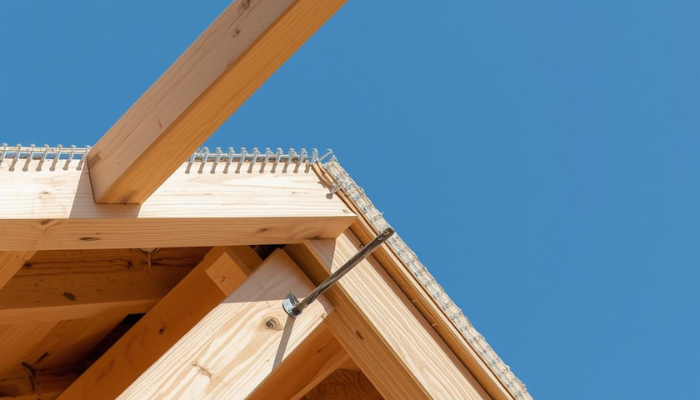
The length of the fasteners is an important factor in your house’s integrity and structural strength. If you’re tackling a roofing repair, or even a full replacement of your roof, it is important that the sheathing connection to the roof rafters be strong enough to resist wind uplift as well as the weight and pressure from the roof materials.
Understanding How Long of Screws for Roof Rafters
When contractors or DIYers ask how long of screws for roof rafters should be, the standard answer usually depends on the thickness of your decking and the required penetration into the framing. In most cases, the screw must penetrate 1 inch (25mm).
When using 1/2-inch and 5/8-inch standard plywood, you should use a structural screw of 2 inches or 2.5 inches. If you use screws that are too long, they can cause the wood to splinter or the decking to pull away in a windstorm.
Key Considerations for Fastener Length
To determine how long of scrfews for roof rafters you specifically need, consider these variables:
- Sheathing thickness: Thicker material will require longer fasteners to meet the 1-inch penetration rule.
- Density of material: Different thread patterns may be required for hardwoods compared with standard SPF (Spruce Pine-Fir). Roof rafters.
- Local building codes: Check with your local authority, as high-wind zones may require specific spacing and lengths.
Can I Use 7/16 OSB for Roof Sheathing?
The most common question during framing is: Is 7/16 OSB suitable for roof sheathing? In general, yes. However, your roofing beams must be spaced out at either 16 or 24 inches (depending upon the OSB grade).
The calculation of how long of scrfews for roof rafters is the same when using 7/16 OSB. However, you need to ensure that the screw head does not crush the OSB flake, as this can compromise the grip strength.
Structural Integrity and Lap Roof Rafters
In roofs with complex designs, you might encounter roof rafters where two roof rafters overlap over the central bearing point. The fastening patterns become even more important in these situations. The load will be transferred to the wall correctly if the sistering is done properly. Experts at Onlyroofing emphasize the fact that transition points, where you lap roof rafters, are most likely to cause structural deflection when the wrong fasteners are used.
Installing Best Practices
- Do not overdrive screws: Make sure that the screw heads are flush. Overdriving will reduce the thickness of the sheathing.
- Resistance to Corrosion: Use galvanized screws or exterior-coated screws in order to avoid rusting during future roofing repairs.
- Space: Use a spacing of 6 inches along the edge and 12 inches in the center.
By accurately calculating how long of scrfews for roof rafters, you ensure a roof that is not only leak-proof but structurally sound for decades to come.
