
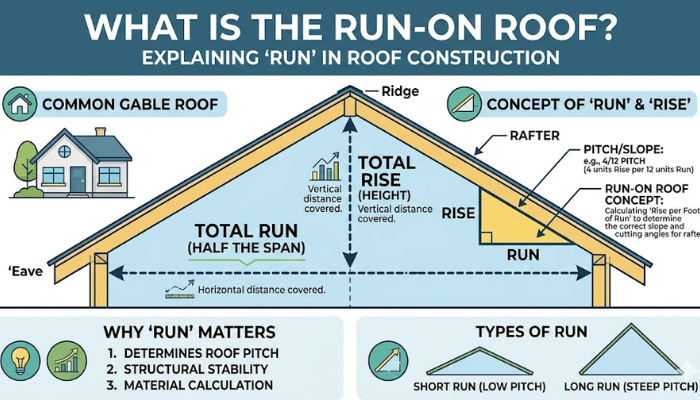
Before you begin any structural work or roofing repair, it is important to understand your house’s geometry. The term “run” is one of the most commonly misunderstood in the residential construction industry. They often ask what the runon roof means in terms of the pitch and slope on their home. The run is the distance from the top of the wall to the point below the ridgeboard.
Defining the Geometry: What the Runon Roof Means for You
The run, when calculating slopes, is “the base” of your triangle, made up by the rafters. The run of a standard Gable Roof is usually half the span of the entire building. What the runon roofing allows contractors from only roofing to determine the length of the rafter and the amount required for the project.
Professionally, the ratio between rise (vertical distance) and run (horizontal length) can be expressed in a number such as 4:12 (or 6:12). The ratio will determine which membranes or shingles are best for your house. When planning to replace your roof with a new one, you will need to accurately measure the runon roofing. This ensures the roof pitch is steep enough to use standard shingles.
Structural Requirements and Sheathing Selection
The next step in the process is to choose the decking. Which Thickness OSB For Roof? In general, the standard industry thickness is 7/16″ or 5/8″. The decision is often based on:
- Panel Thickness: A 24-inch space typically calls for thicker 5-/8-inch panels.
- Snow load: In heavier climates, decking needs to be stronger in order to avoid sagging.
- Fastener Grips: Thicker wood gives nails more meat to chew on, and this is important for wind resistance.
The Impact of Run on Roof Design
The roof runon has a direct impact on the “tread”. You will have a shallow pitch if the run is longer than the rise. A short rise with a long run creates an abrupt peak. Onlyroofing professionals use these measurements in order to determine the area of the deck.
The Technical Checklist For Measuring Run
- Measure the Run from the Outside Edge: Always take the measurement from the outer edge of the wall plate up to the middle of the ridge.
- Take into account Overhangs. Keep in mind that a run doesn’t usually include the “tails” or eaves of the rafters, which extend beyond the wall.
- Look for Symmetry. Asymmetrical designs may have a different run from side to side.
Understand what the runon roof means to ensure that you are making accurate structural calculations, which will prevent waste of materials. It also helps ensure long-term durability and protection for your house against the weather.
