Homeowners planning an energy-efficiency upgrade often ask the same question: is it better to insulate ceiling or roof? The answer depends on your home’s structure, attic use, and long-term energy goals. Both approaches have distinct advantages, and understanding them helps you make a decision that saves money and improves comfort year-round.
Understanding the Difference
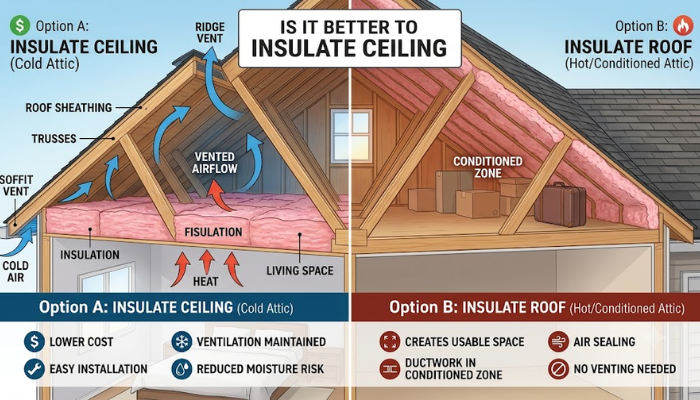
Ceiling insulation sits between the living space and the attic, while roof insulation is installed along the roofline itself, right beneath the rafters. When deciding is it better to insulate ceiling or roof, it’s important to know that ceiling insulation is generally more affordable and easier to install, making it the go-to choice for most standard attics.
Benefits of Ceiling Insulation
- Lower material and labor costs
- Faster installation with minimal disruption
- Keeps the attic space cooler, reducing heat transfer into living areas
- Works well with blown-in or batt-style insulation for ceiling applications
Many contractors recommend ceiling insulation as the default solution because it directly targets the thermal boundary between conditioned and unconditioned space. If you want to insulate the ceiling effectively, focus on air sealing gaps first, then adding adequate R-value material on top.
Benefits of Roof Insulation
Roof insulation is ideal for homes with finished attics, vaulted ceilings, or HVAC equipment stored overhead. Since the entire roof deck becomes part of the conditioned envelope, this method offers better temperature control for multi-purpose attic spaces.
Special Cases Worth Considering
- Insulated ceiling tiles are a practical option for basements, garages, or commercial spaces needing quick thermal and acoustic improvement.
- If you want to insulate garage ceiling areas, ceiling-level insulation is usually more cost-effective than insulating the entire roof structure.
- Homes in extreme climates may benefit from combining both methods for maximum efficiency.
Which Option Should You Choose?
So, is it better to insulate ceiling or roof? For most homes with unused attics, ceiling insulation offers the best return on investment. For finished or actively used attic spaces, roof insulation provides superior comfort and moisture control.
Before starting any insulation project, ensure your roof is in good condition. Learn more about roof drainage systems or check details like what scuppers are on a roof, how soffit and fascia match your windows, and what OSB thickness works best for roofs to ensure a
